Pages

Thursday, August 29, 2013

So, you want to teach Business English in Germany...?

Herzlich Willkommen!  You will find teaching in Business English in Germany exciting and rewarding, I'm sure.  But beware, its not all lessons in the Biergarten.  Here are ten things to help you work in Germany.

1.  German is a very hard language

There is a saying in German "Deutsche Sprache, schwere Sprache," which translates to "German language, difficult language."  Recently, football club Bayern Munich hired Pep Guardiola, the spanish legend, as their new coach.  He was hired roughly six months before he was to take on the position and was living in New York.  During that time he took German lessons to prepare for his new job.  He now gives interviews and leads press conferences in German.  In comparison, it took Franck Ribery nearly five years in the league to give his first interview in German.


The commentary in the press routinely praises Pep for his amazing achievement.  His German is B2 level when he is fully prepared, A2 when answering spontaneously (my evaluation).  I have never heard criticism about Franck taking so long to adopt the language... after all it is very difficult.

In reality, it is not that difficult to learn.  To be sure, the gender pronouns cause considerable problems (der, die, das) and the problem is compounded because they affect adjectives.  Additionally, the Accusativ, Dativ, and Genetiv cases can be confusing, especially when dealing with prepositions.  In some cases, the resulting grammar makes no logical sense.  However, the German language has a set of fixed rules, which when learned, never change.  There are very few exceptions to the rules and with proper study (and some memorization) the levels become easier as you go along.

Of course, English is the exact opposite.  There is a lot grey area in English grammar.  This something that takes some getting used to.  My students are dumbfounded when I tell them, "Well, both are correct."  I often have to explain the difference between prescriptive and descriptive grammar.  Recently, the Süddeutsche Zeitung ran and article on English as Lingua Franca and said English grammar is "rudimentary". In short, Germans are often looking for rules when there are none and continually frustrated by exceptions (which abound).  They are surprised to find that we don't have a Duden, an official guide to correct German usage, upon which to evaluate correctness.

Some students will directly say that British English, in particular Oxford English, is correct.  This also includes received pronunciation.  While they have a point, focusing on this type of English may not have the most practical use.

So, in the end, I am not surprised at Pep Guardiola's achievement.  In fact, I would expect better from six months of classes (presumably one-to-one and intensive) with a crystal clear needs analysis.  German students, however, are often surprised at the difficulty of English as they improve.  It is a good idea to provide learners with 'guidelines' rather than 'rules' when necessary and use activities which teach a better feeling for the language rather than simply correct and incorrect.  When doing this, however, be prepared for resistance.

2.  Germans have two conflicting learning settings

If you start of a new class by outlining expectations for a course, you will probably be confronted with two very different methods of teaching.  The first is "learning by doing".  The students just want to talk.  They are often completely satisfied with a conversation class punctuated by some corrective and lexical feedback from the teacher.  The "bring in an article, read and discuss" lesson plan meets these expectations nicely and is even recommended by the students occassionally.

In the book "Der, die, was?  Ein Amerikaner im Sprachlabyrinth" the author David Bergmann humorously tells the story of learning German and it's idiosyncrasies.  In the book he mentions advice from Germans to "simply speak"... that is the best way to learn.  He compares this with learning a piano concerto by simply sitting down and starting to play.  Yet, many of your students will undoubtedly think that they can magically improve their language without any input or focused practice.


Along with this is the 'common knowledge' that you can only truly learn a language through immersion.  Occasionally, I counter this by presenting research which shows only mixed results for total immersion without a guide.  I also relate my own story about living in Germany for seven years without teaching.  My vocabulary was quite large but when I started lessons, I was still placed in the A1 group because I didn't understand even the most basic aspects of syntax and grammar.

As a result, one of the most important lesson to pass on to German students is 'noticing' the language around them.  Your students will certainly have a range of English exposure through news, television and signage (not to mention daily business).  Yet they rarely notice these words and I'm constantly surprised when they don't know an English word which is commonplace in German media.

The second learning method, which is less common, is the 'magic wand' learner.  These are the students who come to classes with the mistaken belief that somehow the teacher will transform them into English speakers through no effort of their own.  I believe this stems from their school experience in which English was often taught by lecture.  The teacher talks, the student listens, the student takes a written test to prove their knowledge.  This method has evolved in German schools now, but adult learners still carry this baggage.

This means that students might question (sometimes directly) the purpose of an exercise/class activity.  For example, guided discovery grammar teaching is unsuitable.  I've had students simply refuse to do the activity because they didn't see the point.  After all, the teacher's job is to teach, the pupils' job is to listen and learn.  So, sometimes it is best to clearly and directly state the pedagogical reason for a certain activity.  "This activity is designed to..."


So, you are likely to have classes in which the learning expectations are completely different.  One part of the class would prefer maximum speaking time and very little structured input.  The other part expects maximum teaching input and clearly structured practice activities.  Finding a middle can be a challenge and requires a certain bit of finesse.  Sometimes this means having clearly defined conversation and input driven lessons.  Sometimes this means teaching them about second language acquisition and methodology.  Sometimes this means changing people's minds about learning.

3.  German employees don't do homework

Clocking in and out at work is much more than an administrative task for German employees, it is symbolic ritual which signifies their distinct separation between work and personal lives.  Only the most dedicated students will do homework.  Typically you can use homework to distinguish goals.  Those who see English as a benefit for their personal happiness will do homework.  Those who see English only as a necessary tool for their work will not.

I wrote about this topic last year and I believe my previous post is still accurate, but the effects are limited.  Even with the most elaborately planned tasks and persuasion, I can still only get about 50% completion of homework.

This limits the trainer in many ways.  First, multi-session lessons are difficult to pull off.  Starting a topic in one lesson and continuing for weeks is a challenge.  Second, the flipped classroom is largely impossible.  Imagine assigning background reading for a lesson and then having one student complete it.  Third, more elaborate skills training is questionable.  I still typically assign presentation to my classes but I rarely have more than 75% actually create and deliver the presentations.  Fourth, vocabulary practice is almost zero.  If they need to increase vocabulary, it is best to limit the aims of the face-to-face lesson and hammer the words during the lesson.

4.  Verb tenses are a bitch (yup I used that word)

Judging by the coverage of verb tenses in international course books and websites, I'm sure that Germans are not alone.  But I have seen some interesting aspects of learning verb tenses among my learners.

First, they are obsessed with them.  For many grammar = verb tenses (called 'times' in German).  I can almost guarantee that you can walk into any German classroom, ask about their needs, and verb 'times' will come up.  Add in the grey areas I mentioned above and you have room for chaos.  Add in the 'magic wand' student to the mix and you have a recipe for disaster.

Second, their school teacher confused the hell out of them.  It is a useful exercise for a teacher in Germany to do a little tutoring for a while to get an idea of how they learn English in the schools.  English is now taught starting in the fifth grade (and sometimes vocab is taught earlier).  In the sixth grade it gets serious.  In the first three years of school English, the students are ask to master the Present Simple, Present Continuous, Past Simple (called the Simple Past in Germany), the Present Perfect, the Present Perfect Continuous, the Past Continuous, and the four future forms.  In year four, they are hit will the Past Perfect, Past Perfect Continuous and the future perfect forms.

A normal school year has 37 weeks with about 2 hours of English per week.  If we throw in testing (written and verbal), we are down to about 60 hours per year of class time.  Imagine trying to teach all 12 verb tenses (plus passives) in 240 hours.  Holy cow!  No wonder they are confused.  Adding to the issue is the fact that students often believe, for example, that the Past Perfect is just as important as the Past Simple.  After all, it was taught with the same emphasis in school.  I've even had students come to class proud to show me a table they made of all twelve verb tense forms plus passive.

So, here are some of my recommendations for teachers.  First, limit the number of tenses you cover in class but make sure they understand when to use them.  Second, expect interesting sentences.  The Present Perfect is, of course, the bugbear for Germans (the same form has a different meaning in their language).  But interestingly, they will be hesitant to use the Present Continuous while at the same time overusing the Past Continuous.  Third, spend considerable time on the future forms.  The prevalence of going to, will, and the present continuous for the future warrants a look.  Germans don't normally use a modal or verb form for the future so will be uncomfortable with it.  Finally, the difference in meaning is important enough to examine in class.  I have developed special ways of teaching these verb tenses to fit my learners... I encourage you to look at your methods.

5.  They are amazed that German and English are related

I don't know why but my student never seem to see how German and English are related.  There are so many words which are the same or nearly the same in the two languages.  Be prepared for questions like, "What mean organisieren in English?" or surprised faces when you say "Bratwurst is Bratwurst in English."  I guess Bier and beer doesn't quite do it.

I have also never met a German student who was not fascinated by loan words.  In fact, you can base an entire lesson on words like Schadenfreude, Kindergarten, and Zeitgeist.  I tend to think they few this patriotic revenge for all the English words they have adopted such as 'Shitstorm', 'Handy', 'Mobbing' and 'entertainment'.  The first three fit nicely into the loan word lesson because they have different meanings or usage.

But in essence, my students routinely fail to see the parallels between German and English.  This makes translation exercises particularly useful in the classroom.  For example, Germans are often confused by the second conditional because it uses the past tense.  First of all, I have decouple the form from time (handled in the verb tenses lessons) and then I can show them how it has a close cousin in German.  German has a rarely used, but widely known, subjunctive form which corresponds closely to the German preterite form (Past Simple).  Suddenly, when they see Old German matched with English they see the connection.  By the way, most schools do have lessons on Old German.

6.  There is only one register in German

Okay, this is not quite true, but register in German hinges on three things:  filler words, pronunciation and personal pronouns.  There are certain domain specific words like darüberhinaus (moreover) which are used in a super formal register, but for the most part Germans do not change words to change register.  For a German learner it is interesting to translate everyday spoken German to see register contradictions in English.  For example, "Dude, did you obtain the confirmation for your residency visa?"  or "Listen man, the requirements are totally confirmed."

One element of German is that distinct concepts have distinct vocabulary.  The same it true of English, but they are actually used in everyday German.  My four-year-old son routinely produce sentences with vocabulary which, when directly translated, would sound like a lawyer.  "I have consistently demanded that my brother stop hitting me!"

Register in German is primarily determined by eliminating regional dialect and speaking 'high German' (Hochdeutsch).  Primarily, this means removing regional filler words like fei, gell, echt, and na.  This also means reducing the dialect pronunciation.  Where I live, for example, /p/ and /b/ are pronounced the same (soft /p/), they same is true for /t/ and /d/ (soft /t/).  When they change register, they pronounce them correctly.

For the teacher, this poses a problem.  You will have to teach the students that the deciding factor for register in English is word choice.  I typically start by saying, "Okay, in German you change the pronoun 'you' (Sie and du).  In English, we change everything else in the sentence."  But most learners equate 'informal' English with 'unprofessional' English.  In some cases this is true, but in nearly all cases, the learners simply do not have the lexis to speak unprofessionally.  For example, I've never met a student who can produce the sentence, "Dude, I'm like totally stoked about this presentation!"

7.  Pronunciation is not a huge problem

When we think of German speakers we often attach the convenient Arnold Schwarzenegger accent.  But I find that phoneme pronunciation is not a major problem.  Sure, some work on the /th/ sounds is needed to keep them from sinking about sings.  And at the very beginner level water can sound like vater.  'Were' is often a beginner issue at well.  But for the most part, students sort these individual sounds out quite quickly.  In fact, I am often impressed at how my students handle the quintessential problem areas like 'through' and 'enough'.  Plus, long words can be tongue twisters.  Here is a list of words which nearly always cause problems.
  • clothes
  • debt
  • negotiate
  • unfortunately
  • graduate (both noun and verb)
  • photographer (my wife is one, so we find this often in my lessons)
  • apprenticeship
But for the most part, individual word pronunciation is quite good.

The main problem is sentence level pronunciation.  This is also, sadly, the area which teachers are least prepared to handle.  While the words are said correctly, be prepared for the 'German machine gun', bang-bang-bang-rat-tat-tat-tat.  You may even find that your students look at you questioningly when you go over short forms.  Expect revolt when you bring up wanna, gonna, and gotta.


Why?  Well, read number 6.  German register is typically defined by clear pronunciation.  Teaching them short forms is equivalent to teaching them 'bad English'.  Add in a few 'Oxford English is the right way' students and I hope you can find the explanation out of the mess you created.

Also, Germans are hesitant to show emotion through intonation.  They will use intonation frequently to avoid difficult question forms (for example... You live in Munich?) but will not be prepared to pause after adverbs of commentary.  But this general lack of emotion while speaking fits with the next point.

8.  Communication skills are mediocre to poor

Yup... I said it.  I'm sorry Germany... but your overall communication ability is below average.  You write poor emails, deliver boring presentations, and write indecipherable documents.  In most cases I trace this back to the education system and the German language.  As some of you may know, Germans do not receive a 'liberal education'.  They get a very basic background in humanities up to age 16 before they move on to subject specific practical skills.

University graduates are often the exception, but less than 20% of all high school graduates attend university.  In addition, you are not likely to find them in your classes because their English is typically at least business survival level, in most cases verhandlungssicher (able to discuss = proficient).

This means that the car mechanic is totally amazing at fixing cars but horrible at talking to customers.  Taking it a step further, the engineer (through technical school) knows everything about the technology but pisses all his international colleagues off with his emails.  Of course, I am making stereotypes just as others make them about pronunciation, but there is a certain amount to truth here.  As a teacher, you may have to point to the long-term benefits of relationship building at the expense of short-term clarity.



To be honest, this is difficult line to walk as a trainer.  Most certainly there are cases in which direct words are needed.  American and British communication trainers are often confronted by the opposite, conflict and directness is avoided at all costs, resulting in unclear expectations.  But there is a middle ground here, and the trainer in Germany should seek to find it.  When it comes to leading meetings and giving presentations, there are certainly tips which constitute best practice.  Most of your students will be unfamiliar with them, both in theory and in practice.

9.  They appreciate the outsider's point of view

Germans are crazy about feedback.  This includes everything from their language to their country to their culture.  However, I have noticed that they prefer for it to be delayed until they are finished speaking.  Interruption is generally taboo, both mid-sentence and mid-story.  For linguistic mistakes and gaps, it is generally best to record and highlight later.  Most of my students prefer seeing their language written and improved rather than hitting them mid-stream.  To be honest as learner, so do I.

The second thing is about differences in opinion.  Occasionally I have lessons in which one of the student takes the discussion off on an anti-American tangent (there are ample opportunities for this).  The NSA data security issue has been the latest in string of possible 'What the hell is America thinking?' subject.  Gun control was the topic of the spring.  The presidential election was last fall.  But no matter if it is political or simply about the best way to organize a to-do list, differences of opinion will appear in your lessons.

I have found that no matter how integrated I am in Germany (in fact that helps me build extraordinary trust), I am still the outsider in the room.  They count on me to bring in viewpoints from outside their world.  In fact, a simple way to change the dynamic of the classroom from me asking them questions is to get them to ask me about America, the world, and how we see Germany.  This particularly suits the 'learning by doing' expectations of learners and as long at the teacher watches the talking time, can make for a productive lesson.

For example, most Germans are surprised to learn that "Made in Germany" actually means what they think around the world.  They are surprised by the American fascination with the Autobahn and Mittelstand.  They rarely think about punctuality until it is in the context of another culture.  Likewise, they are truly confused by the concept of patriotism and how it affects worldview.

As I've mentioned in intercultural training posts before, it would be a good idea for the trainer to understand the underlying values of German culture before trying to discuss these issues.  Perhaps I'll blog about this in the future, but the key is to stop using utilitarian reasoning and check out some rights-based ethics.  Objectivity to key and truly appreciated.  No one appreciates criticism from an outsider, but an objective evaluation is interesting.  I find that Germans are intrigued by neutral analysis and have some kind of underlying desire to be evaluated.

10.  Germany is not a nation, it is collection of similar regions

Following the previous point, it helps a teacher in Germany to understand which region he/she is in.  Each holds its own traditions and culture which are preserved with pride.  I mentioned patriotism above, which will generally be foreign to most of your learners.  For them patriotism is generally about cheering for the German national team at the World Cup.  After the two months is over it is back to those "shit Bavarians".  Likewise, Bavarians think everything northwest of Frankfurt is the Ruhr area, an industrial wasteland of welfare recipients and broken down societal systems.

There are many reasons why stereotypes and rivalries exist in Germany, some going back centuries.  It may be too much to ask for a trainer to dive into history and ethnography to try to understand them.  But the artifacts of this are clearly visible and provide ample opportunity to fruitful lessons and discussions.

First is dialect.  Picking on dialect is one of the prime sources of humor in Germany and they can talk about the differences at length.

Second is food.  In Bavaria, food translates to sausage.  In fact, I could hold entire lessons on the differences between bratwursts.  I certainly don't look down on this.  I am from Kansas City and I could describe all the minute differences in barbecue across the US and advocate clearly why KC has the best.

The third is football.  The football team you cheer for says a lot about your personality.  Enough said.  Also, I have never met so many women season ticket holders.

Finally, we have values and beliefs.  If you are new to Germany, let me give a short beliefs overview.  The south is Catholic and conservative.  The west is Protestant and liberal.  The east is less religious (although  Protestant) and focused on whichever method can fix the problems they have (population loss, unemployment, immigration, extreme nationalism).  Certain cities have special attitudes.  Munich is the city of snobs.  Berlin is poor but sexy.  There is growing tension in the media between international gentrification and true Berliners.  Cologne (Köln in German) and Hamburg are the most open cities.  Dortmund, Duisberg and other cities in the Ruhr area are the blue collar hubs of Germany.  Stuttgart makes cars (Porsche and Mercedes) and money (large Mittelstand).  The Turks are in all the main cities, each claiming to have the largest group.  It is best to stay away from this issue as far as you can, especially as you may have second generation Turkish in your class.

One of my hangouts in Berlin during my CELTA, the Irish pub around the corner was my planning HQ.

So, for me this means that I have to balance conflicting beliefs in my classes.  The majority of my learners are Franconian (a part of Bavaria, but distinctly proud of their regional identity... dare I say nation).  About a quarter are immigrants from within Germany, mostly from the former East Germany.  And a small percentage are from other countries who have moved to Germany for opportunity.  But regional culture makes for interesting and engaging lessons.  People like talking about their identity and it provides great contexts for role plays.

So, watch out for these things I'm sure you'll have as much teaching in Germany as I do!

Bis dann...


Wednesday, August 14, 2013

Widening the Feedback Channel

Let's talk about feedback.  Without question, Business English Trainers are dedicated to feedback.  We understand it as a valuable part of the communication process.  We attempt to instill it in our learners by giving then useful phrases for obtaining/giving feedback as well as the benefits.  In many cases, our lessons are largely feedback driven.  We observe the language and interject to provide linguistic input for clarity, style, and meaning.  Giving effective feedback is one of the crucial elements of being an English Teacher.

Sometimes we distill this skill to 'error correction', but any trainer can tell you that feedback is much more than simply 'mistake hunting'.  I see that I have not blogged about the '4 Levels of Listening'; perhaps I can do it soon.  In the meantime, you can look at a professional development workshop I ran last year which mentions the topic.


Surprisingly, what I see is that trainers are quick to preach feedback and reluctant to take it.  This is understandable.  Easy to say, harder to do.  Negative feedback hurts.  After all, we have worked for hours to do our best only to find out that our effort was wasted.  What an insult!

But I follow the words, "Feedback is a gift."  As I move forward with a few long-term projects, widening the feedback channel is vital for helping me design and refine engaging and productive lessons.  I have learned to crave negative feedback and integrate it every step of the way.  Honestly, positive feedback is less important to me because I walk into most lessons thinking that the agenda is truly engaging, helpful, and worthwhile.

Here are a few methods for obtaining valuable feedback.

Feedback Trading

At the end of a lesson, say that you will give feedback on their performance if they give you the same.  Typically this is written and often involves a structure.  For example:

I will give you three focus areas for you to work on in English communication.  You give me three things I should do as a trainer to meet your expectations.

This takes about 15 minutes and with larger classes some preparation may be needed.

Flip chart - keep/change

Draw a t-line on the flip chart.  On the left side write "keep" and on the right "change".  Ask the learners to tell you what elements of the training we should keep and what elements we should change.

For example, in my recent classes I have found that they want to keep the variety of the lessons and the feedback-based instruction.  However, they would like to read more articles and play Taboo.  No problem... I introduced more reading/internet searching into the class and we play Taboo for 30 minutes once a month (I bought the real UK version on Amazon).  Attendance is higher than before.

Meet one-to-one

To be honest, this is most difficult method of feedback.  First, learners do not like to tell the trainer bad things.  Maybe they do not have the learning experience to even make a comment.  Second, it lacks the anonymity of written feedback.  Third, they are unaware of their peers' expectations of the course and hesitant to impose their demands on the group.

However, when handled properly, individual meetings can provide key insights into what is going right and wrong with a course.  These are particularly valuable after an extensive time with the group (when they know the group dynamics).  The key for the trainer is implementation with confidentiality.  In other words, when you change something, make it look like a pedagogical idea.

-  Learner desires a traditional and structured approach to learning
-  Trainer: "I know we don't normally do gap-fills, but research show that they are useful for remembering vocabulary.  Here is a gap-fill I created, you have five minutes to complete it."

Important:  When you receive negative feedback, do not attempt to justify your actions... just take it.  Stand there, nod your head, and take it.  It hurts sometimes.  You can direct the conversation to another person, "Jim, what do you think?" but you should not answer.  Write it down and think about it.

Colleague status

This is clearly limited to certain courses and special environments.  But this is the goal of every group I teach whether in one department or from diverse groups.  I want to build trust to the point that we can talk openly about every element of the training (and the business).  The colleague status is developed by combining the three in-class methods mentioned above plus regular communication, dedication, and common goals.

The hardest part of my job is convincing them that my satisfaction comes from watching them succeed (in fact, the most student I lose are those without goals).  I truly believe that if your inspiration is entirely self-serving, then you will never be able to deliver the service needed to maximize value added.  But this convincing takes time.  It is not an approach they are used to.

This means regular engagement with the learners to find out their problems, help them through them within the business constraints, provide accurate input at the time of need, etc.  In essence, value comes from being an integral part of their work life.  Running off copies and preaching about the Present Perfect Continuous does not normally do it.

Once feedback is constant in both directions, you will find the the glass doors to the person/business open wide and lead to immense value added.

Conclusion

While I have discussed three feedback techniques, the final element of colleague status is truly the pinnacle of excellent training and customer service.  The first step is that we seek, accept, and finally crave feedback from our learners in the same way they desire it from us.  It can change the entire dynamic of a class or project and considerably impact contract renewal and wages.

Wednesday, July 24, 2013

The Jigsaw - Creating an Information Gap

I guess the two things that stick out most clearly from my teacher training course are 1) go out and learn English grammar/vocabulary as a non-native speaker, and 2) if you want to create speaking and communication in class you need to have an information gap.  The purpose of this post is to dive into that communication gap in in-company training.

The problem with in-company training is that the largest communication gap in the room is between the trainer and the learners.  The trainer possess the English language, and the participants have the business, the processes, the products, the suppliers, the genre, the conventions, the organizational structure, the goals... nearly everything.  Thus, it seems natural that many in-company courses would revert to an ongoing dialog between the trainer and the learners.  The learners explain the business and the trainer explains English (and in my case, why Americans have so many guns).  The learners actually seem to enjoy this communication gap.  They have safety in numbers, they do more listening than speaking, and they learn one or two things.  The curious trainer (like myself) also enjoys this dynamic because "when one person teaches, two people learn".

But I find myself increasingly annoyed by this classroom dynamic.  When I leave a class which devolves to this I chalk it up as a failed lesson and reflect on critical points where I could have guided it in another direction.  I recently performed an annual review of a project I am working on and it led me question why some groups had seen more progress than others.  I began testing hypotheses against groups outside the project.  Indeed, it appears that I see more progress and improvement when I am able to step back from the lesson and create information gaps between the participants themselves.  The survey responses say they have more progress when I am less involved (whether through teaching style or group dynamics).  No surprise, right... less teacher talking time, more functional language needed, etc.  So the answer must be to hand them role cards and sit back to take notes.

Unfortunately, the answer is not quite that simple.  Here a few things to consider when meaningful information gaps in class.

1.  Many people are information workers.  Their value to the company depends on their knowledge of processes and how to do things efficiently.  They are defensive about this.  I simple task such as "Teach the group how to file their travel expenses in SAP" can nearly eliminate their purpose of employment.  Once the group sees how simple the process is, the worker may feel they have to defend their value to company.  Of course, this does not merely apply to lower level workers.

'Silo thinking' can apply to many companies.  This means information can travel up and down in the hierarchy, but not across departments.  This may be the case when there are profit and cost centers for each department and internal pricing. In other words, department X charges department Y for services even though they are the same company.  Additionally, both have sales targets so they can give away too much information to others.

Lesson:  Be aware that information is power and internal pricing means that customers and salespeople may be in the same room.  When designing simulations, don't ask the students to give up more information than needed.

2.  Roles are not needs.  There are several cases in which I have given a student a role and they are simply a prop to the lesson.  The job is simply play the part so that the person next to them can practice specific needs.

This is a lack of creativity on the trainer's part.  I can do better by adapting the role-play or simulation to fit both needs.

Lesson:  Read the role cards critically.  If the overall role-play fits we may want to change "Student A".  This can be as simple as changing the word colleague to manager and vice versa.  The key is to look at the roles and imagine the conversation... does it fit the needs analysis?

3.  More than only jigsaw reading.  In the past we were constrained by the fact that content could only be delivered in written form.  If you are looking for the #1 education app... it is YouTube.  Give one group of students the tablet and watch a video on the laptop in the other room.  When accompanied by a supporting activity... bam!  An information gap.  Exploit it.

 4.  Simulations with different mindsets.  Six Thinking Hats was first written 13 years ago by Edward de Bono.   History has shown that it is largely false; people are simply not that consistent.  If you have not heard of it, he proclaims that lifestyle and values determine approaches to a problem.  Mr. de Bono defined six different thinking styles including speculative, creative, and emotional.

But while it may be useless as a determiner of personal values, it is helpful in training to create differences of opinion.  The lesson is quite simple... the trainer gives the learners a routine situation and assigns various roles based on the various mindsets.

An example of all combined:

You are tasked with assessing a bid for Russia Railways.  (This is a realistic role-play)

  • Give mindsets to various students and initiate a webquest. (Naturally, the roles are targeted.  But this lets the students hide a bit with plausible deniability.)
  • Due diligence:  What did you find?
  • Additional research:  Send groups to watch and report on various videos about the subject.
  • Agree on the overall need/benefits
  • Divide project tasks based on need.  This can go on for several lessons.

So...

Creating an information gap within in-company courses is simple and easy to do.  But the even easier communication gap between trainer-students is a default setting of teachers.  The basic factors to a successful role-play is a data gap, a difference in purpose, and various approaches to a problem.  At the same time, we need to remember that the learners need a certain buffer or plausible deniability.  After all, their value to the company depends on how much they know.


Thursday, June 13, 2013

The Value Chain of Business English Training - Chapter One

There are several parallel conversations going on in Business English training at the moment.  The first is about money.  The second is about qualifications.  The third is materials.  There are certainly other issues, but I’ll limit it to these today.

The purpose of this article is to link these three threads and to give a few signposts out of the circular debate.  The link to all of these lies in business theory.  As Business English trainers, I hope this is familiar, but perhaps the application to our own field is new.

Porter’s Value Chain

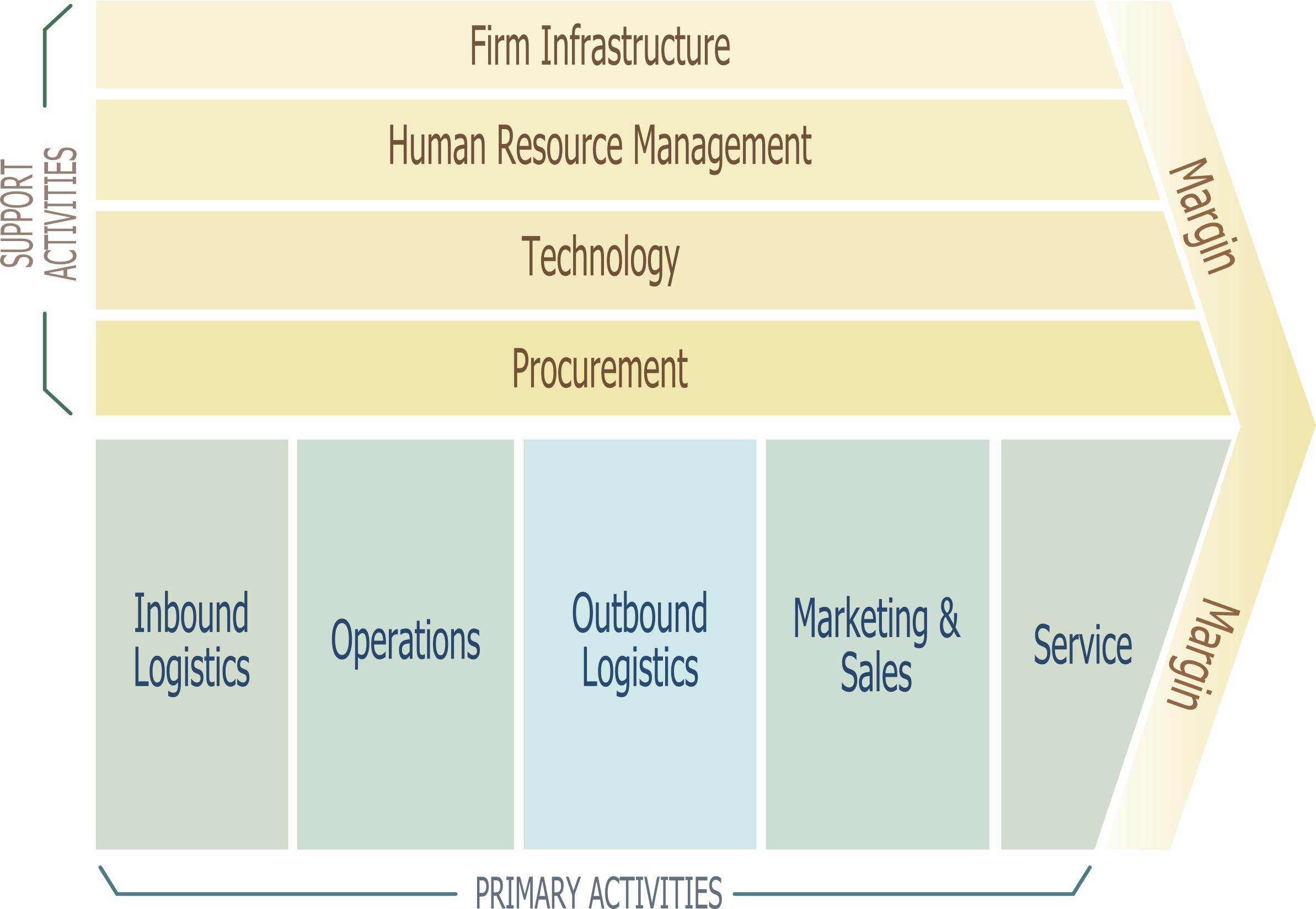
Perhaps the most well-known name in business theory is Michael Porter.  In 1985, he presented the value chain, which explains the difference in price between the inputs and output of a business.  I think the clearest graphic of this process is from Wikipedia which shows a notional value chain for a manufacturer.


The business functions in blue are the primary functions of the business in transforming the raw materials into a product and selling that product to generate profits.  The functions labeled in brown support those primary activities and generally do not add value in themselves.  These are also typically the first business functions to be outsourced.  The difference between the cost of running these activities and the final price is the profit margin.  Each firm will have a different value chain, but all will resemble this model.

The Value Chain for Business English Training

Now, let’s take this model and apply it to Business English training.


The raw material of BE is the English language, which is a common good.  It belongs to no one and if you grew up in a native-speaking country you have it free-of-charge.  Indeed, there are enough resources and materials on the Internet that the language is available at no charge around the world.  Therefore, the main value of the trainer is to determine which parts of this massive body of knowledge are needed, organize that information, then transform it into a useful format for learning, mastery, and performance.

Overall, the first three activities are determining what to train, and the last two are how to train.  These primary activities include everything in training from using discourse analysis to determine key functions to elearning.  Additionally, materials development includes more than simply course books and handouts, but also the activities a trainer uses to instill knowledge, mastery, and performance. 

Note: It can be argued that marketing actually adds value but I doubt few trainers will be able to develop a brand with enough mass to considerably change what a client is willing to pay.  For simplicity I have left it as a supporting activity.

Why wages are so low...

Jenny has a CELTA and works at a private language school.  She is given Business English courses and travels to an accountancy for a 90 minute lesson every week.  The school and the client have decided to use a course book for the training.  Jenny supplements the material with some of her own activities and modifies some of the exercises in the book to better fit the needs of the group.  She conducted a short needs assessment at the beginning to find out which parts of the book are more important for the learners.  She is not that familiar with the company but she has read the company’s website and remembers some accounting from a university class she took several years ago.  She is very active reading blogs and articles to find creative lesson plans and activities to improve her teaching.

In the case above, Jenny is only one very small part of the value chain (marked in red).  The other primary activities were done by the course book writers/publisher (they were paid when the book was bought) and the brown support activities were done by the school.


Let's imagine the market price for this type of training is €60 per hour.  If Jenny gets a third of that, she is lucky.  Her limited needs assessment is added value and her addition of supplementary materials helps.  Most likely, she will receive a bit more than her peers at the school who do not do this.  But her professional development is limited to improving her training delivery.  This is admirable, but does nothing to increase her wages.  She is already receiving this portion of the value chain.

Susan has a CELTA and is a freelance trainer.  She started with general Business English courses but then started focusing on finance.  Every two weeks, she attends a local networking event for business leaders in the area.  At one event she meets a partner of one of the local accounting firms.  She talks about her business a little and how she has worked with other firms in the field and has seen good results.  She has developed a corpus of financial English and writes her own materials based on common functions and skills.  Prior to the training, she researches the firm and meets with a few of the partners to conduct a top-down needs assessment.  Then she conducts a bottom-up needs analysis with the participants.  She designs a course proposal and negotiates with the accountancy.  She then develops the materials and conducts the training.  Every month she invoices the firm and sends a progress report to the partners every quarter.

Again for simplicity, let’s assume that Susan is also subject to the same market rate for Business English training at €60 per hour.  But in this case, Susan collects every cent of the value chain.  Additionally, she is developing skills and tools which enhance her ability in other activities.  Over time, she becomes more proficient at billing, reporting, marketing and sales.  She checks on activities and methodology but is more interested in workplace discourse, specific needs in the field of finance, etc.  So, she does not ignore how she teaches, but spends an equal amount of time on what she teaches.

The end result is that Jenny spends three times the amount of time in the training room as Susan.  That does not mean Susan works less, but she is doing different things.  Additionally, Susan is developing skills which will help her earn even more money in the future, whereas Jenny is continually improving an activity she has already tapped (training delivery).

In the next chapter we will discuss the relationship between qualifications and the value chain to see how hitting the books will help increase wages.

The Value Chain of Business English Training - Chapter Two: Qualifications

How qualifications add value...

The ELT community and Business English in particular has rightly made the link between qualifications and earnings, but in the wrong way.  It is useful look at a few qualifications and what they really mean.  

First, the basic qualification to be a teacher is possess more knowledge about something than the learners.  This means that every English speaker in the world is qualified.  There is no way to create a barrier for entry.  In fact, there is probably no other field with a lower barrier of entry.  Providers will always hire from this pool and provide them with everything they need to conduct training.

A qualification demonstrates to clients a certain level of expertise in certain parts of the value chain.

The basic qualifications are a TESOL certificate or CELTA.  This shows a certain ability to conduct training.  In Jenny’s case (see previous post), she able to work for the private language school because of this certificate, probably earns a bit more, and has some more freedom in designing materials and activities.  But in essence, the certificate now really belongs to the school.  They will be able to gain a slightly higher price from the client because they offer a certified trainer.

Now, if we talk about university degrees in (Applied) Linguistics, this demonstrates a deeper knowledge of the subject matter.  The corresponding assumption is that these qualifications improve the ability to determine what part of language to train.  This is certainly valuable as fields like pragmatics emerge within Business English.  But to say that they will immediately translate into higher training rates is a bit exaggerated.  They will only allow the trainer to better identify certain skills needed, divide those skills into sub-skills, and prioritize them.  For example, within the main skill relationship building we have the communication skill of small talk.  One linguistic sub-task of small talk is showing empathy.  A trainer with a degree in Applied Linguistics will be better able to identify this sub-skill and develop linguistic strategies for performing this sub-skill.

If we turn to Education as a field for certification, this demonstrates a deeper knowledge of the how to teach.  This will show that the trainer is an expert in creating learning materials and delivering the training in a way that is easily absorbed.  A degree can be very useful, but it is important to remember that it supports only certain elements of the value chain.  The trainer may design and conduct outstanding training, with high learning and performance results, but which is also only marginally relevant.

The DELTA and MA TESOL could be considered a blend of these two fields in the context of ELT.  They appear to do a better job of improving all aspects of the value chain to a certain degree.

The final qualification would be a degree or certification in a special field, such as law, engineering, or finance.  This will typically help when defining the skills needed.  These degrees solely support the what side of the value chain.  But it is unclear which qualification would be most useful.

When in doubt, ask the customer...

I had a meeting with one of my clients a few months ago and we talked about an ongoing training project I am working on.  He is a manager in procurement and pays my bills.  If he is not happy (either with me or because the participants complain) I will lose my job.

During the meeting I started talking about my approach to training (materials light, maximum feedback, skills focused) and he cut me off. 

“I don’t need to hear about how you do things.  You are the trainer and you know the best way.  I am interested in making sure we are training them things that will help them do their job better.  We aren’t here to teach them ‘English’.  They should bring that with them when they are hired.”

Translation:  I see that you are an experienced and qualified trainer.  I’m assuming you know what you are doing and I have not heard anything to make me doubt that.  For me, the main value is the focus of the training.  Are you training them in skills which are applicable to their daily work, or are you sitting in there talking about grammar?  I’m not interested in how you train, rather what you train.

This client is not alone.  Most of my clients are more worried about the content than the approach.  From the client’s side, the methodology debate is a non-starter.  They do not care if you know Dogme, task-based learning, or the like.  What they really care about is whether you are training them things they can do in their job.  The method is only important in that is achieves results and satisfied learners.

This leads me to believe that qualifications which support needs assessment and skill analysis are more profitable.  There are several examples of this.  Some trainers are doing quite well with a law degree.  Evan Frendo is an engineer and mentioned how useful this has been in a recent interview in Business Spotlight.  On the other hand, ELT specific degrees and qualifications seem to only marginally pay off because they do not necessarily resonate with the client.

This what worries me somewhat about the planned teacher qualification scale being drafted by organizations such as British Council and Göthe Institute.  These scales will be designed based on their business model of teacher, DOS, and  director or on the university system.  In my experience at a private language school, the client was not willing to pay significantly more for a DELTA trainer than a CELTA trainer.  On the other hand, they easily handed over a premium from a trainer with a field specific qualification like a project management certificate or business degree.

In chapter three we will discuss ways we 'give away' parts of the value chain and limit our income.

The Value Chain of Business English Training - Chapter Three: Outsourcing

Outsourcing value...

In the first chapter of this epic post, we discussed the value chain of Business English training.  In the second, we looked at how qualifications can add to that chain.  In this chapter, we will look at how we outsource various elements.  In essence, this is the ‘follow-the-money’ of ELT.

A few years ago, one of the companies I work for decided to outsource their IT services.  As a support activity, it was not directed related to generating value for the company’s customers.  The provider who took over the services basically said, “Look, this isn’t your core business, you aren’t experts in it, and if you let us take it over, we will do it cheaper and faster.”  The company agreed and suddenly all the IT services came from a different company... for a fee.

We do the same thing with our support activities.  I hire a tax consultant to support my operations.  Sure, I could file the monthly VAT returns myself and produce all the financial statements, but that is not my core business and they can do it cheaper and faster.  I hire a part-time secretary to do all my invoicing and billing.  I have outsourced my administration.

We can take this a step further and outsource our marketing, sales, and infrastructure as well.  By working for a language school, we are sacrificing a certain amount of the income.  They control that side of the value chain.

Materials...

But the real outsourcing comes from using published materials.  For this post, we will ignore the “how to teach” books and instead focus on the learner-centered materials.  Just like the IT example, course book writers and publishers basically say, “We know which skills the learners need, we can break them down into sub-skills, and we can present this knowledge in a useful way.”  In many cases, they are right.  Published materials work, I have no doubt.

However, I have certain reservations about outsourcing my primary value added activities.  I can see that others feel the same way.  Often this comes in the form of half steps.  For example, a trainer may conduct a needs assessment and even go so far as to analyze those needs into sub-skills.  Then they will photocopy a range a published materials to fulfill those sub-tasks.  This effectively cuts the publisher out of the value chain and leaves more for the trainer.  In reality, the school may encourage this behavior because they are actually pocketing the difference.  They are telling the company that they create customized courses (which are sold at a slight premium) but are only paying the trainer for the value added of training delivery.

This is one of the most delightful ironies of the ELT field (Business English included).  Many of the same school directors, directors of study, and teacher trainers who are developing their career to write for a publisher are encouraging or ignoring ubiquitous copyright infringement at their institutions.  But it all makes sense from a business point of view.

The key to this system is the assumption that the client and the learners do not know the difference.  And in many cases they don’t.  However, as someone who writes all of his own material I can say that there is a HUGE difference in value to the customer when you say, “I did a corpus analysis of your field and I wrote this exercise booklet on 40 verbs that are common in your field.”  As long as the materials I write are pedagogically sound and support the sub-skills I am looking to train, they add considerably more value than photocopying published materials.

This weekend the BESIG is hosting a free online conference all around materials.  The talks they have lined up appear to address this issue head on.  I believe that writing materials for clients is one of the greatest values I provide.

The key to outsourcing the value chain is knowing what to leave to others and when.  In general, most companies do not outsource their primary activities.  In Business English training, however, sometimes we may need to focus only on the things we are paid to do.  If I am only allocated the training delivery step, I will expect the school to provide me with a needs analysis, an assessment tool, and materials for the training.

But in reality, there are many trainers taking less pay than the effort they are putting in.  In thenext chapter we will look at how to gain more control of the value chain.

The Value Chain of Business English Training - Chapter 4: Getting Paid

Building your share of the value chain...

We all want to get paid for what we are worth.  In chapter one, we saw how the trainer Jenny had nearly maximized her wages because she was adding only limited value to the training.  In fact, there is a cap on each step in the value chain.  For example, you might do the very best needs assessment ever, but a customer will only pay so much for that step.  You might also be the best materials writer in the world, but there is still a cap.

If we combine this with qualifications, it shows that they are subject to diminishing returns.  In other words, a Master’s in Education will not change my income that much as a trainer because I may have already reached the limit of what customers are willing to pay for materials development (including activities) and training delivery.

So the key is to take over more elements of the value chain, not to continually develop and market one step.  This means the trainer will have to do more work.  But before we look at four ways to increase value added we need to examine a fact about the consulting/training business.

Customers always remember the first price you charged them.
- Joe Rei, Management Consultant

Rates are sticky.  It is extremely difficult to go to a customer and ask for higher rates.  But we can never stop developing our product.  Furthermore, a training product needs testing, review, and improvement before it can be sold.  That leads to the first value building method.

1.  Test something with customer A and sell it customer B

Jenny is running her weekly business course at the accountancy, but she is unhappy with the pay.  She decides to use corpus tools to make her own materials about accounting and the needs she has identified.  She goes out and learns how to use the software and collects the texts.  It takes her many hours of work, but she eventually writes three vocabulary exercises and a role-play based on her data.  She uses the materials in class and sees that there are a few problems.  She corrects them and writes a few more.  She is not being paid for any of this effort.

When the class ends, she gets great feedback and the school wants to use her for another course focusing on financial English.  Jenny speaks with the director and says, “I can develop my own materials for the course.  I’d be happy to show them to you prior to the training.  But this takes considerable effort and I would need to be paid for it.  I believe the customer would be willing to pay for materials if they knew that they were specific to their company.  I think it would be fair to receive the materials budget for this course.”

2.  Take on the responsibility... go freelance

Mike Hogan has talked about going freelance at conferences a few times and he is right on that it is more difficult, more rewarding, and can pay more than using the support of an institution.  This is the path I chose and I love it, but it is not for all.  I also had certain abilities in every step of the value chain before I started out on my own.  I am not a success story yet, but I believe I am on the right track.

When it comes to assuming responsibility for marketing, sales, and product development, a freelancer must be patient and have a certain confidence that sales will come.  I have been turned down for many more proposals and offers than have been accepted.  I have been rejected by far more prospective customers than I have won.  In general, I believe that it will be another 3 to 5 years before I am really able to maximize my value.

3.  Take a share of value from others

This is the traditional money making model in ELT.  Course book writers take a certain portion of the value for every student who uses their book.  Elearning sites charge a fee for their material and delivery.
I know some trainers who have won a customer and then hire other trainers to perform some of the training.  They keep a portion of the income for the sales work and admin side.  They may even keep a larger portion if they conducted the needs assessment and designed the training program.  Private language schools who hire freelance trainers generally follow this model.

This method is simply not for me, but that doesn’t mean it doesn’t work.

4.  Use synergy gains to increase value

Synergy gains are a business concept for when two companies working together will produce greater value than the sum of working individually.  In this case, I am talking about working with other trainers to ‘bundle’ services which has a higher price than individually.  For example, I worked in the past with a human resources development consultant here in Germany.  She was an expert in outplacement to help employees find a new job when they were laid off.  Her services were typically paid by the company the employees were let go from.  We worked together in special cases to combine her training and support with my English training.  Together we were both able to charge higher rates.

For me, this is the ideal situation.  I am always looking for talented partners who have complementary skills.  By utilizing our various talents, we can approach customers with a larger added value.

Conclusion

At the end of the day, there is little we can do about the business model of Business English training.  The barriers for entry will always be exceptionally low.  And there will always be a place for under-qualified trainers in the marketplace.  I believe the best qualification to differentiate a trainer is something beyond the ELT field (assuming they have at least the minimum teaching certificates).  I also think writing materials is key to adding value to the training and makes a significant impact on clients.  Finally, there are several ways to increase rates within the field, but these methods must follow business principles.  I don't think following an academic career model attracts customer.